Introduction
In the unfathomable depths of the infinite , great beings vie for control of fantastical realms, where powerful magic imbues every living thing, and even the land itself. Take on the role of a powerful Avatar in one of these realms, and tap into the arcane energies of the four elements—Air, Earth, Fire, and Water—to mythical beasts, ancient artifacts, and cast an array of powerful spells beyond all imagining. Will you claim dominion over this contested ?
Using this Rulebook
The goal of this rulebook is to get you up to speed and ready to play your first games of Sorcery: Contested . For new players, carry on from here, have someone guide you through a game, or visit www.sorcerytcg.com/how-to-play where you'll find tutorial videos and more. For experienced players, this rulebook will handle most of your queries, but you can also explore the Codex (curiosa.io/codex) for even more detail.
The game uses terms and keywords that are important to know. When these come up, they have been bolded to not only help you identify important words and concepts, but to also tell you that you can find more information about that word in the glossary, starting on page 32.
Gameplay
In a game of Sorcery: Contested , you with the as a powerful Avatar. You will have a spellbook, a deck of cards that will allow you to cast spells that minions, artifacts, and more. You will also have access to your atlas, a deck of cards that allow you to add wondrous sites to the play area that both expand your domain and empower you to cast even more devastating spells.
How to Win
Avatars are summoned to a contested with one goal: to vanquish their opponents and claim sole dominion. In order to win, you must defeat any opposing Avatar by first reducing their total to zero, placing them at , and then delivering a final to the weakened Avatar. This severs the 's connection to the and grants you victory!
Decks
For your first few games, you might want to use preconstructed decks, which will get you straight into the action. Or you can craft your own decks, balancing and tuning their powers to fit your play style. The world of Sorcery grants you endless possibilities!
The Four Elements
Sorcery: Contested is built around the four classical elements: Air, Earth, Fire, and Water. Most spells in a spellbook are tied to these elements, giving Avatars the power to manipulate the magic of the realms. Each element has strengths and weaknesses. Certain abilities can be common in one element yet very rare in another. The four elements and their characteristics are:
AIR
Air is the element of Knowledge and Power, dabbling in forces beyond mortal control to acquire the magical means to respond to any battlefield situation. An attunement with air grants you both mobility and tactical options thanks to its ability to teleport around the and to increase its available spells.
EARTH
Earth is the element of Enduring Strength, defined by its focus on fielding and enhancing martial forces throughout the . An attunement with earth grants you the ability to affect your atlas and minions that can dominate the battle through teamwork and sheer fighting power.
FIRE
Fire is the element of Desire and Destruction, willing to do whatever it takes to secure victory in the . An attunement with fire grants you an array of explosive spells and abilities that can create bursts of speed or burn friend and foe alike in great gouts of flame.
WATER
Water is the element of Charm and Trickery, ready to adapt and disrupt the strategies of the as it manipulates all. An attunement with water grants you a powerful homefield advantage that will slowly engulf the and the ability to position the right where you want them.
Cards
In Sorcery: Contested , your cards are what allow you to influence the and do battle with your opponent. Some cards will bend or even break the rules in this rulebook, in these cases the card's text takes precedence. Before we dig into how cards function in detail, it is important to keep one key rule in mind at all times:
The Golden Rule
Some text is intentionally informal or necessarily compact. Use common sense and be cool.
Card Types
There are three main categories of cards: Avatars, sites, and spells. Spells further break down into four card types: minion, artifact, aura, and magic. The following pages will describe each type.
AVATARS
Your Avatar represents you and your connection to the . Though but a pale echo of your true might, everything you do within the is done through your Avatar. Avatars have some key characteristics:
- Each Avatar has a name①.
- Avatars have a starting ②, which will rise and fall during the game and tells you how much the Avatar can endure before being placed at . This is also the Avatar's maximum , which cannot be exceeded.
- Avatars also have an attack power rating③that tells you how hard they hit in combat.
- Avatars have a game text box④ that describes their special abilities.
All Avatars are Spellcasters, which means they can cast spells, most often from your hand.
Finally, Avatars can never enter a other than the surface and ignore many negative effects.
Units
A unit is a collective term that includes both Avatars and minions. Some cards might specify one of these types of , but most affect in general.
SITES
A site is a locus of power within the that you may explore and exploit. Sites are usually played by activating your Avatar's ability, though they may enter the in other ways.
You and your opponent can also attack each other's sites to cause your Avatars to lose , so make sure to defend yours.
Sites have some key characteristics:
- Sites have a name①.
- Sites have a typeline② that describes key things about that card, such as rarity.
- Most sites have elemental symbols that increase your elemental affinity③, which you will harness to use spells and abilities.
- Sites have a game text box④ that describes their special abilities.
- Sites will provide you with , an important resource that you will need to play cards and use abilities during your turn.
- Sites have two levels: surface and subsurface.
Rubble
When a site is destroyed it is placed in its owner's cemetery as normal, but rather than creating a new , the site is instead replaced with . is a neutral land site that no player controls, and provides no or threshold.
SPELLS
Spells represent all of the magical might you are able to bring to bear on this . These include minions to help you defend your lands and attack the , powerful artifacts that will help you tip the balance of power, magics of channeled energy that will overpower foes, and auras of lasting elemental magic to impose your will on areas of the .
Minions
Minions are your greatest allies, assisting you with myriad abilities in offense and defense. Minions have a few key characteristics on their card:
- Each minion has a name①.
- Each minion has a cost② that you must pay in order to play it.
- Minions have an elemental threshold③that your elemental affinity must meet in order to be played.
- Minions have a power rating④ that reflects how hard they hit in combat. It also describes how much damage they can take before dying. If the minion receives damage equal to or greater than that value, it dies.
- Minions have a type line⑤ that describes key things about that card, such as subtypes and rarity.
- Minions have a game text box⑥ that describes their special abilities.
Token Minions
Tokens are small-sized cards that work more or less the same as regular cards while in the . The major difference between cards and tokens is that tokens are never part of a player's deck, and they can never formally exist in any zone except within the . If a token would be placed anywhere else, it is instead removed from the game entirely.
Artifacts
Artifacts are various relics, edifices, tools, gear, gadgets, devices, and baubles, often charged with lasting enchantments by wizards of old. Artifacts have some key characteristics on their card:
- Each artifact has a name①.
- Each artifact has a cost② that you must pay to play it.
- Artifacts have a type line③ that describes key things about that card, such as subtypes and rarity.
- Artifacts have a game text box④ that describes their special abilities.
Artifact Subtypes
Artifacts have a variety of subtypes, including armor, weapons, relics, devices, documents, automatons, or monuments. While most artifacts are standard objects that can be carried into battle, others such as automatons and monuments have some further characteristics and restrictions.
Automatons
Automatons are artifacts that are minions. As such, they have a power rating⑤, have the same basic abilities as regular minions, and cannot be carried like regular artifacts.
Monuments
Monuments are an artifact subtype that cannot be carried.
Auras
Auras are mostly incorporal, but lasting, manifestations of elemental power. They usually impact a large area within the , conferring boons or conditions within their reach.
Auras have some key characteristics on their card:
- Each aura has a nam
- Each aura has a cost② that you must pay in order to play it.
- Auras also have an elemental threshold
③ that your elemental affinity must meet in order to be played.
- Auras have a type line④ that describes key things about that card, such as rarity.
- Auras have a game text box⑤ that describes their special abilities.
Magics
Magics are transient spells that have immediate impact and then dissipate as soon as they resolve. Magics have some key characteristics on their card:
- Each magic has a name①.
- Each magic has a cost② that you must pay in order to play it.
- Magics also have an elemental threshold③ that your elemental affinity must meet in order to be played.
- Magics have a type line④ that describes key things about that card, such as rarity.
- Magics have a game text box⑤ that describes their special abilities.
Game Zones
In Sorcery: Contested , players share the main and biggest part of the play area—the . However, each player has their own decks, cemetery, and hand. These are the game's main zones.
THE REALM
The ①is a 5x4 grid where most cards are played. These twenty squares begin as pieces of the that you and your opponent may fill in with sites as you expand your domains.
ATLAS AND SPELLBOOK
Each player has two decks of cards—an atlas of at least 30 site cards②, containing maps to domains waiting to be explored, and a spellbook of at least 60 spell cards③, filled with all of a player's accumulated magical knowledge. Players will draw cards from these decks over the course of a game. When it comes to these decks, keep a few things in mind:
- The exact order of the cards in these decks is unpredictable, thus whenever you search your atlas or spellbook for a card, you must shuffle it afterward.
- Some effects allow you to place or reorder known cards on the bottoms or tops of decks. After doing so, you do not shuffle it.
CEMETERY
Each player has a cemetery④ which represents a record of spent magic, minions, and artifacts. Whenever any of your cards are discarded, destroyed, resolved, or otherwise expired, place them face-up in your cemetery.
Players may freely examine the contents of any cemetery at any time and the order of the cards in a cemetery is irrelevant.
HAND
Cards drawn from your spellbook or atlas decks are kept in your hand⑤. Your hand should remain hidden from your opponents, however the number of atlas and spellbook cards you hold may be observed and asked, due to the card backs being distinguishable.
There is no maximum hand size and the order of the cards in your hand is irrelevant.
Setup
Now that you're familiar with the components, follow these steps to set up a two-player game of Sorcery.
Step 1: Set Up the Realm
Clear some space in the middle of the table for P the ①.
Step 2: Place Avatars
Players place their Avatars on the in the middle of their bottom row②.
Step 3: Prepare Decks
Players shuffle and place their atlas and spellbook decks ③, leaving some space for their cemeteries④.
Step 4: Determine First Player
Players may either decide who has the first turn, or otherwise randomly choose who goes first.
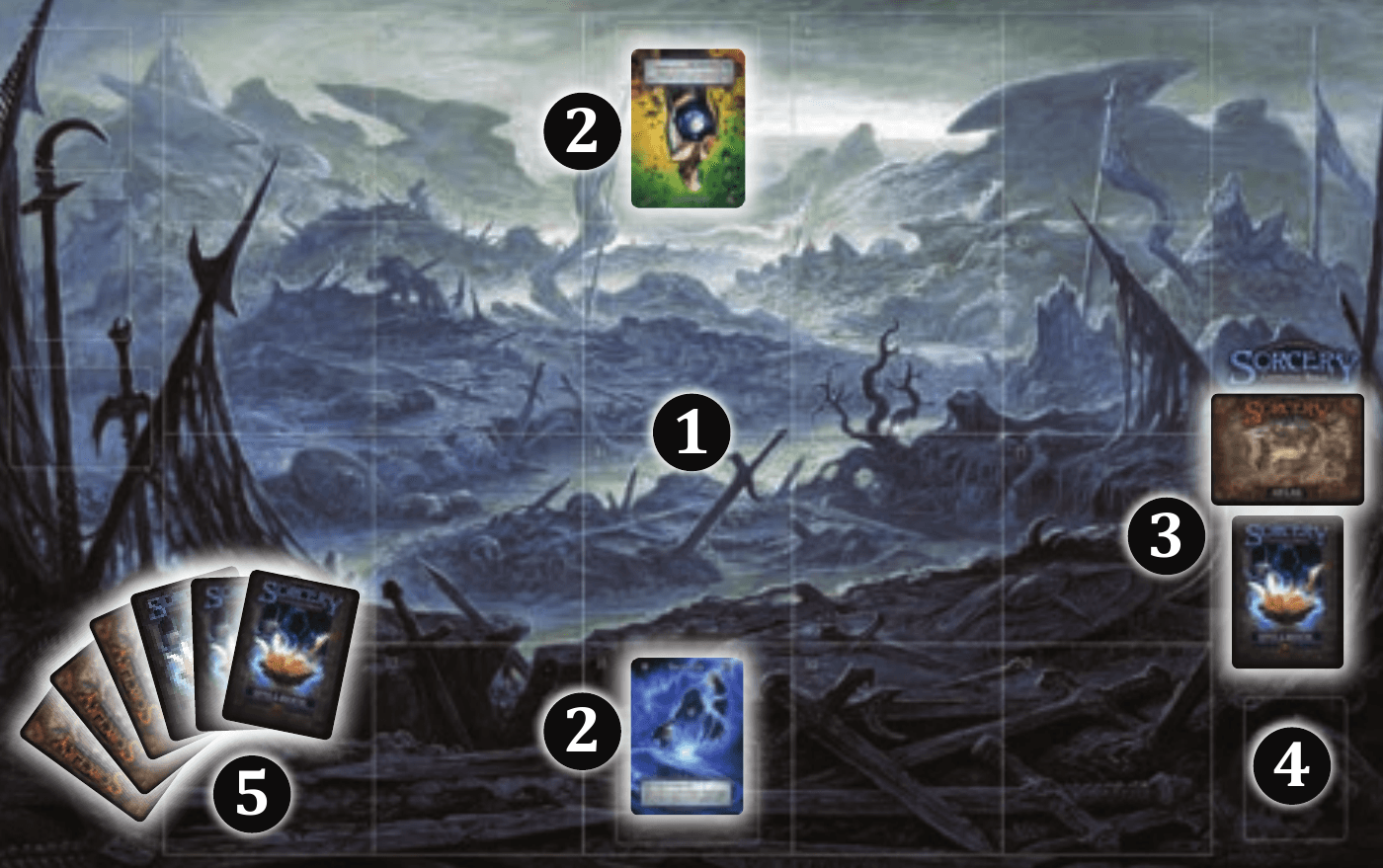
Step 5: Draw Starting Hand
Each player draws three cards from their atlas and three cards from their spellbook⑤. If you're not satisfied with your initial hand, you may take one mulligan.
To take a mulligan, return up to three cards from your hand to the bottom of their respective decks in any order. Then redraw the same number of cards you returned from each deck.
Winning the Game
The game ends when a player has vanquished all opposing Avatars, securing their hold on the ! In order to do this, you'll need to get them to , then follow up with a .
Alternatively, if either player attempts to draw a card from an empty deck, they immediately lose.
Death's Door & Death Blow
As an Avatar loses , from either taking damage directly or their sites being attacked, its connection with the weakens. When an Avatar's is reduced to 0, they are now at and can no longer gain . At that moment, the wounded Avatar becomes immune to damage for the rest of that turn.
After that brief and desperate window, any damage dealt to the Avatar is a , finally severing their connection to the and signaling their defeat.
Navigating the Realm
In Sorcery: Contested battles are often won or lost in the way you position and maneuver your . The following pages will cover how to navigate both the grid and the layers of the .
AREAS OF THE REALM
The is split into twenty squares. These squares begin as pieces of the that you and your opponent may fill in with sites as you expand your domains.
The Void
The is a of incorporal nothingness on top of which you will build your physical domain. Any minion that somehow finds its way into the (whether in whole or in part) is immediately banished (removed from the game) unless it has an ability that specifically allows it to exist there (such as ).
Sites
As you and your opponent expand your domains, you will replace squares by playing site cards on them. These sites will form up to create bodies of water and land for your to traverse and conquer.
Water and Land Sites
Sites can be separated into two main types. are identified by the water threshold icon (marked with▽). All other sites are considered , including sites with no threshold icons and .
Groups of Water& Land
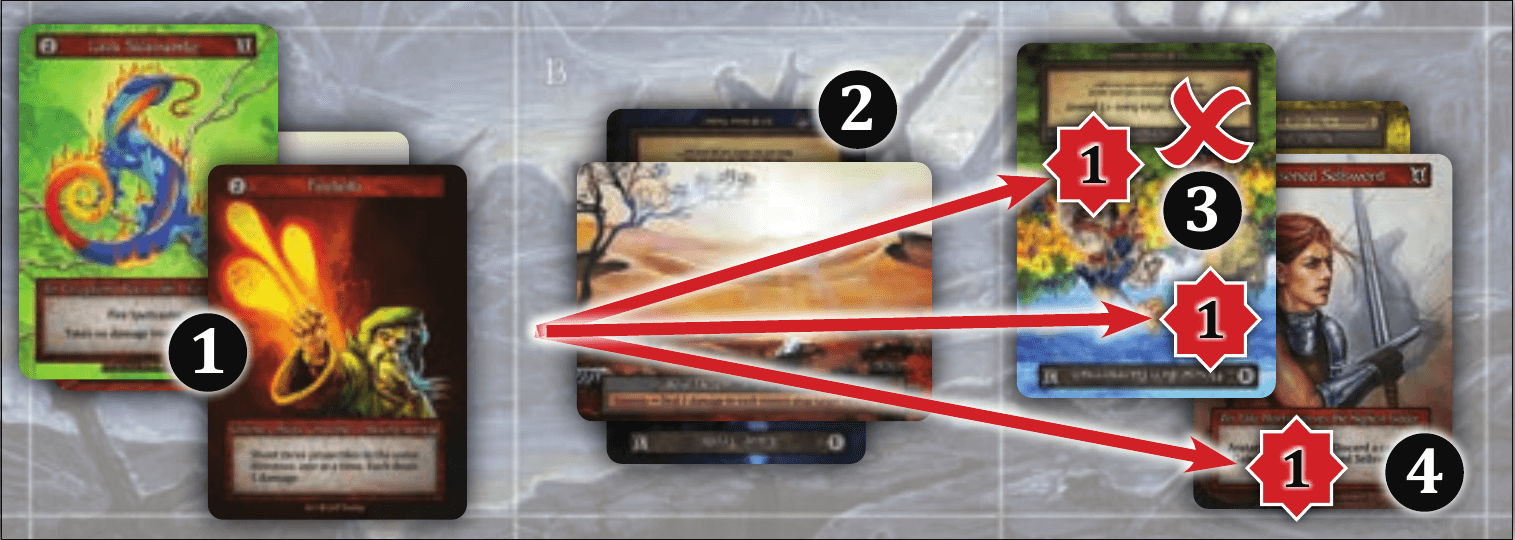
As sites are played, they will begin to form bodies of water and spans of land. A contiguous cluster of is known as a . Similarly, a contiguous cluster of forms a . It is possible to have more than one of each, or for the to be completely land or water.
The Autumn River is a separate, single-site (2), since only sites are considered and not those placed diagonally.
The Steppe and Dark Tower form a (3), and the Arid Desert is its own single-site (4).
Surface& Subsurface of Sites
Each site is made up of two levels, above and below the card. A site's upper level is generally referred to as the surface and its lower one is the subsurface.
The Surface
The upper level of all sites form a known as the surface. This is where will typically move and wage war on the . All above a site are considered to be on the surface.
The Subsurface
The subsurface is divided into two regions, depending on what type of site it is. The lower level of a land site is part of the . Similarly, the lower level of a water site, is part of the . Existing in the subsurface is extremely hazardous and minions that somehow find their way there immediately die, unless otherwise allowed to do so with special abilities.
Atop and Under
When cards enter a site's surface level, place it atop the site to show that it is on the surface, or slide it under the site to show that it occupies the subsurface.
If a card refers to something atop a site, it applies to something on the surface of the site, but not anything below it. Similarly, if a card refers to something under a site, it applies to something in the subsurface of the site, but not anything above it.
Regions
Altogether, there are four regions in the game:
•
- surface
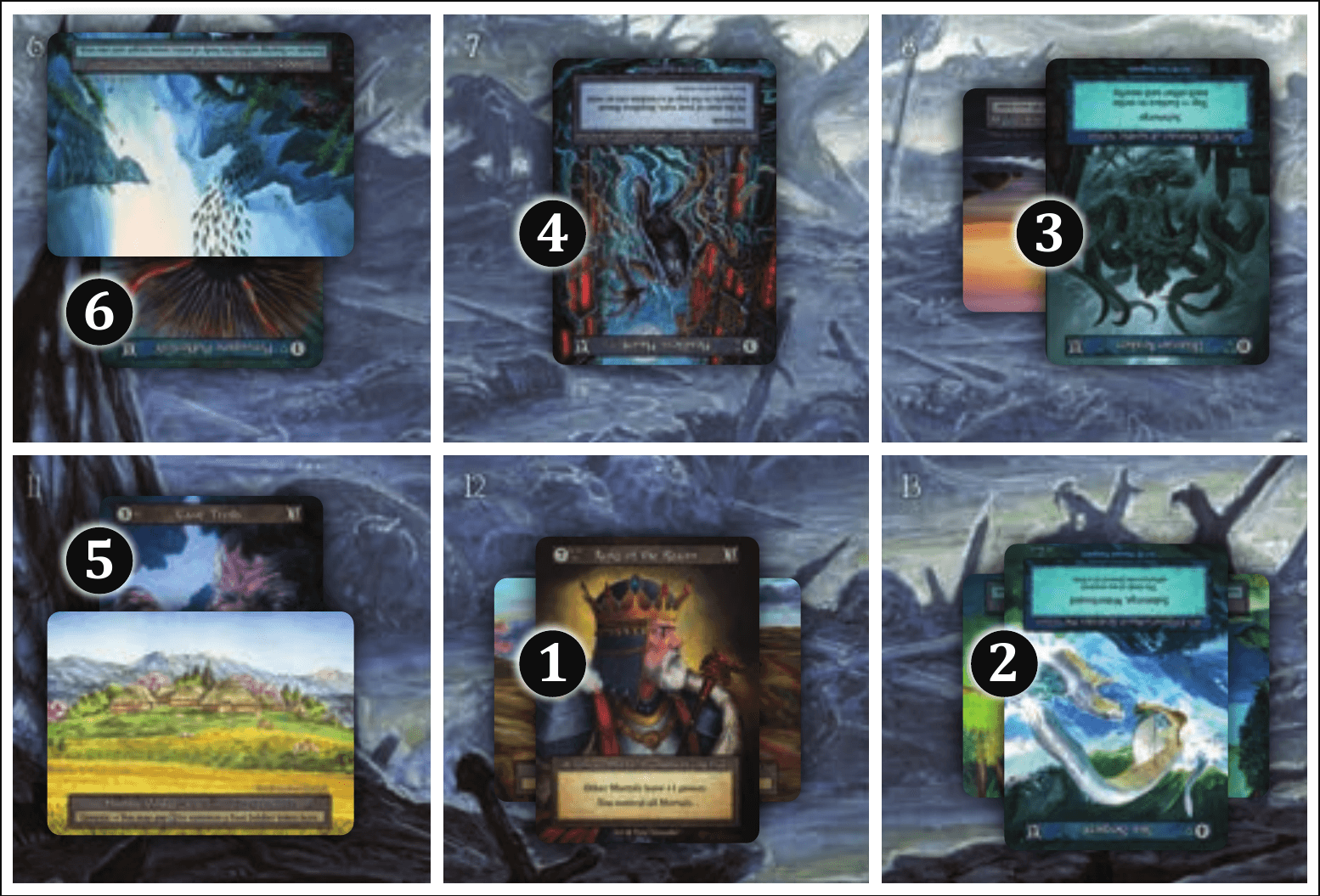
The Porcupine Pufferfish (1) occupies the under the site in its .
The Headless Haunt (2) occupies a in the .
The Cave Trolls (3) occupy the under the site in its .
The Sea Serpent (4) and Diluvian Kraken (5) occupy the Surface atop the sites in their squares, as does the King of the (6) atop the site in his .
LOCATING AREAS OF THE REALM
Perhaps the single most important key concept to understand is how to identify areas in the relative to your card's position.
Interactive Realm
Location
A is defined as one in one .
Here and There
“Here” and“There” are used to contextually refer to the (s) that a card occupies. For most cards, such as avatars, minions, and artifacts, that means one . For most auras, it means the 2x2 area they occupy. For sites, it means two locations, their surface and subsurface.
Targeting
Sometimes you will need to things in the . Spells and abilities can only things within the 's or referencing card's same .
Adjacent and Nearby
Sometimes a card will need to identify something in an or .
- : Refers to the card's own , and the squares that it shares a border with.
- : Refers to the card's own , and all squares that surround it, including those diagonally.
These five squares are to the card
These nine squares are the card
Adjacent and Nearby Locations
Only locations that are in the same as the referencing card (or its ) are considered or locations.
In this example, the King of the ① is beset by enemies on nearly all sides! Some pose a greater threat than others. Let's take a closer look.
The King is to the Sea Serpent② because it is next to him on the surface of the site and therefore in the same . Similarly, the Diluvian Kraken③ is the King.
The King is not to the Headless Haunt④ because the Haunt is in the .
The Cave Trolls⑤ are not to the King because they are burrowed and are therefore in a different . Similarly, the Porcupine Pufferfish⑥ is not the King because it is submerged.
The Pufferfish and Cave Trolls are not to each other as they are in different regions, and , respectively.
Similarly, the Pufferfish is not to the Headless Haunt, nor are the Cave Trolls the Headless Haunt.
Steps
A is the minimum unit of distance between two locations. Some card abilities will have an effect that will happen a away or even several steps away from where the card is or its origin point. In these cases, it will say that it happens X steps away.
Turn Summary
Sorcery: Contested is played over a series of turns. Players take their turns, one at a time, following this sequence of phases:
- Start
- Main
- End
Start Phase
- All of your cards that are tapped now untap.
- All of your sites now provide their mana for this turn.
- Trigger abilities that happen at the start of the turn.
- Draw a card from either your spellbook or atlas. (First player skips this step on turn 1.)
START PHASE
The start phase is the first phase you complete during your turn. All abilities that last"Until next turn"now end. Then:
1. All of your cards that are tapped now untap.
2. All of your sites now provide their for this turn.
3. Trigger abilities that happen at the start of the turn.
4. Finally, draw a card from either your spellbook or atlas.
MAIN PHASE
The main phase is where most of Sorcery's actions and events take place. During this phase, your can be ordered to do two types of actions. They can:
- Cast a spell from your hand if they are a or,
- Activate one of their abilities
You may have your do these as many times as you have resources to do so, and in any order you like. For example, you might move a minion, then cast a spell with your Avatar, and then move another minion.
END PHASE
The end phase is the last phase you complete during your turn.
1. Trigger abilities that happen at the end of the turn.
2. Players remove all damage from their minions in the .
3. Effects that last for your turn now end.
4. Your turn ends.
No Card Draw (First Player)
If you are the first player to take a turn in the game, skip 4 of the Start Phase.
Establishing Your Domain
During your first Main Phase, your Avatar needs to establish their domain within the . To do this, you must use your Avatar's ability to play a site to your Avatar's .
Casting Spells
Spells are the main way Avatars and other Spellcasters influence the . Any card in your hand that is not a site is a spell. You cast these spells to minions, artifacts or auras, and invoke magics. To cast a spell from your hand, you need to identify a under your control to cast it. The and its are by whom and where the spell is being cast. Once you have identified the , spells often have two requirements to play: a cost and an elemental threshold.
Mana
All of your Spellcasters use to cast their spells and some abilities may also draw from this power. You can only gain during your turn and lose any unspent at the end of your turn.
Gaining Mana
At the start of your turn, all of your sites provide one each, forming a pool for you to draw from. When one of your sites enters the , it immediately provides one . If you lose a site, the it provided this turn is not removed from your pool. If you gain control of an 's site during your turn, it does not provide you with until your next turn.
Other card types might also provide turn-after-turn in a manner similar to sites, or simply increase your pool for the current turn.
Using Mana
Spells cost to cast. This is identified by the card's cost in the upper left hand corner. To cast that spell, you must be able to pay the cost from your available . You cannot pay a cost if the amount required exceeds the available.
You could play both the Sedge Crabs and Polar Explorers as their total cost is three.
You don't currently have enough to play Captain Baldassare with his cost of four. However, you do have a site, Maelstrom, that you can play using your Avatar's ability④. Playing Maelstrom would bring your total available up to four, allowing you to play Captain Baldassare, saving the Crabs and Explorers for a later turn.
Elemental Threshold
In addition to , you will often need to meet an elemental threshold to cast most spells or use some abilities. Spells and some abilities will have one or more elemental symbols (for fire, for air,
Elemental threshold is not spent like . It is simply a minimum affinity you must have for the specified elements to use some cards. All artifacts and most abilities have no threshold at all, so you need only to ensure that you can pay any associated costs to make use of them.
In your hand④, you have some minions, including Adept Illusionist and Polar Explorers, both of which you want to play this turn.
Because elemental affinity is not spent or lost when playing cards, you just need to check each card's elemental threshold and see if your affinity is equal to or greater than the threshold. This means that you can play both the Illusionist and Explorers this turn since they each only require a threshold of two, compared to your affinity of three▽.
1
11❷
Mulitiple Element Threshold
Some spells might require affinity with different elements. Like with other spells, you must be able to meet all of a spell's required threshold in order to cast it. So for example, to cast Sir Pelleas, you'll need to control sites with at least one Air and two Water threshold symbols. Cards that have different element symbols count as a spell of each of those affinities. So Sir Pelleas is both an Air spell and a Water spell at the same time.
Casting Minions
When a minion spell has been cast, it summons the minion under your control atop any of your sites, and they remain in the until something causes them to leave play.
Summoning Sickness
A minion that entered the this turn, whether from being cast or from another card's effect, suffers from summoning sickness until the end of turn as it prepares for battle. A minion suffering from summoning sickness cannot tap, or be tapped, to pay for costs associated with any ability. This includes any additional abilities that may have been granted by spells and artifacts.
Casting Artifacts
When an artifact spell is cast, it is conjured into the atop any site you control or directly into the waiting hands of one of your . A unit can carry any number of artifacts.
Casting Auras
When an aura spell is cast, it conjures the aura at the intersection of four squares, though some specify the border between two, or even just a single . Auras are said to occupy the surface of any sites at those squares, as well as any , affecting them (or other things located at those sites) in some way.
Casting Magics
Magics are the only cards in the game that do not enter play when they are cast, and do not have a lasting presence in the . A magic spell simply does what it says it does, and then goes to its owner's cemetery.
Activating Abilities
Avatars, minions, artifacts, and auras may all have abilities that can be activated simply by stating your intention to do so, making any relevant choices (like picking targets), and paying any associated costs Unlike spells, which use costs most often, abilities will use a variety of costs including things like tapping, paying , sacrificing a minion, or discarding cards, among other things. Only the controller of a card can use its activated abilities, and only during the main phase of their own turn when nothing else is already happening.
Tapping a Card
Cards in the can be tapped as a resource, spending their energy as a cost to activate various abilities. Tap abilities are usually written as,“Tap→Ability text.”
A player may also need to tap a card as a cost related to other spells or abilities on other cards.
To tap a card, turn it 90° to the right from its upright position①. A card that has been turned 90° in this way is“tapped,” while an upright card is“untapped.” Cards can also untap at certain points in the game. To do that, simply turn it 90° to the left back into its upright position②.
Playing Sites
Sites come into play through your Avatar's activated ability:“Tap→Play or draw a site”①. However, there are some other cards that can bring them into play as well.
When you play a site, it must be placed:
- on ② or ③,and
- to another site that you control④ or as close as possible to your Avatar if you control no sites.
There can only be one site per grid , which means sites are generally placed on an , permanently extending the physical boundaries of your domain within the . Sites can also be played on , replacing it entirely.
Basic Abilities
All (Avatars and minions) have access to five basic abilities that are not printed on their card. Three are activated abilities that allow them to with the . These are: Move and Attack, which is the ability you'll use most often; Pick Up, and Drop, which both relate to carrying artifacts.
The remaining two are triggered abilities that can perform during the opponent's turn. These abilities are called Defend and Intercept, and are described below alongside their triggers.
Move and Attack
Every unit can tap to activate the Move and Attack ability, which allows it to optionally move, then optionally attack something at its . When using this ability, declare the intended movement path and resolve it. After resolving all the movement, then decide if you attack at that .
Moving your Units
When moving a unit, its journey is down into individual steps. By default, can move one . However, some abilities allow to take additional steps (such as ) and other abilities allow to take steps diagonally or even into different regions.
To move a unit using the Move and Attack ability, you first declare each the unit will take, and then you resolve the steps in order. When you declare movement, the only restriction is that you may not repeat specific steps.
Normally, this means that you will simply declare a single , from the surface of one site to the surface of an site.
If your have movement-enhancing abilities, or there are movement modifying effects in play, you might choose to declare a more complex path. As you resolve each , you confirm that it is a legal at that moment. If it is not legal, you do not take that , and continue resolving anything remaining. If your unit takes at least one , it has moved; if it takes zero steps, it has not moved.
“Take a Step” verses“X Steps Away”
If an effect instructs a unit to take a or move one , the unit may modify its via abilities like , , , and .
If a card instructs you to pick a up to X steps away, you cannot apply movement abilities; you simply count one per , without changing regions.
Attacking the Enemy
You may only attack or the surface of sites that are at your . When using the Move and Attack basic ability, you must resolve any movement before declaring and resolving your attack. As you resolve the attack, you confirm it is a legal at that moment, and if so, your unit has attacked.
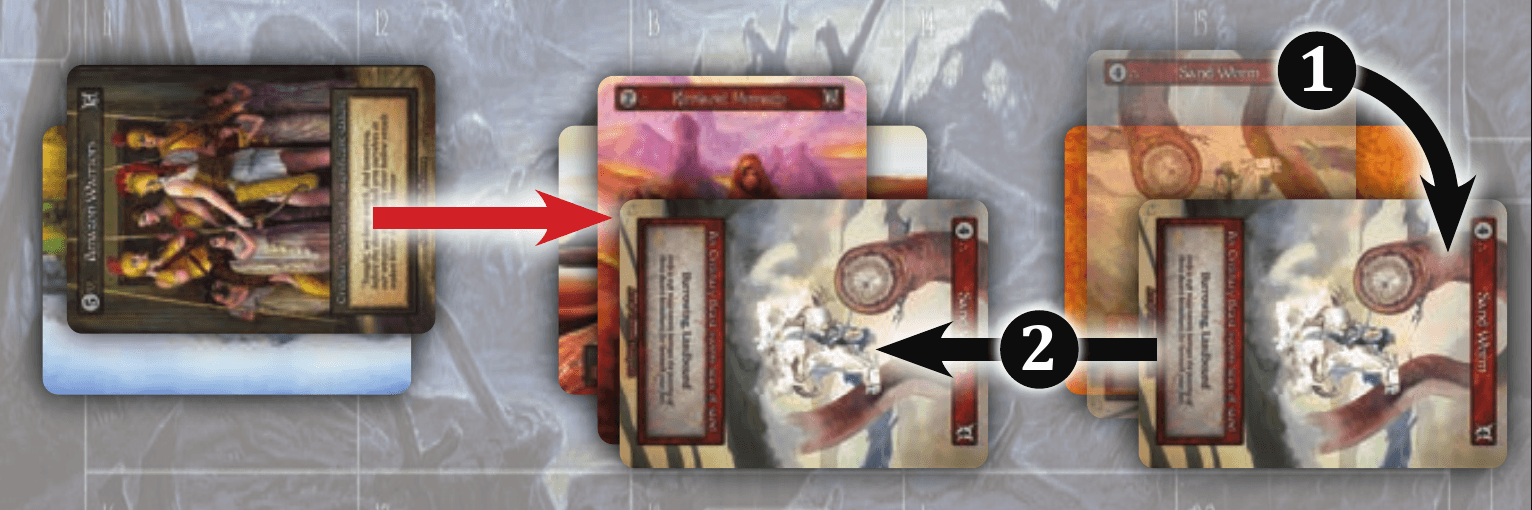
Attacking For example, the Amazon Warriors tap① to declare a Move and Attack. The Amazon Warriors first declare and resolve their movement②. Once they're done moving, they have the option to attack.
Attacking Enemy Units
If you attack an unit, either as your original intent, or because your opponent defended, the involved will . To , each other simultaneously. When a unit strikes, it deals damage equal to its power.
Fight and Strike
Carrying on from the example above, the Amazon Warriors and Rimland Nomads now , striking each other simultaneously③.
The Amazon Warriors deal five damage to the Rimland Nomads who deal two damage in return.
Striking First
Some may be able to land their blows before their can respond. that resolve their strikes before their can resolve theirs. If multiple in the same are able to , they all at the same time. Then any surviving without that ability make their strikes.
Multiple Combatants
If more than two are involved in a (usually as a result of intercepting or defending), the controller of each side may allocate their ' damage among the as they wish.
Minions with Split Power
Some minions have their Power split into an offensive value, or Attack Power and a defensive value, known as Defense Power. When it strikes, use the first one, and when damage is being allocated to them, use the second.
Cards that modify a unit's Power do so to both Attack and Defense Power, so for example Overpower will increase both Attack and Defense Power by two.
Attack Power is noted on the left over the sword, and Defense Power is on the right over the shield.
Damage to Minions
Damage dealt to minions persists until the end of the turn. A minion that accumulates damage greater than or equal to its power immediately dies and is placed in its owner's cemetery.
Continuing our attack example, the Amazon Warriors suffer two damage from the Rimland Nomads④.While this does not kill them, if they take three more damage this turn, they will die. On the other hand, the Nomads suffer five damage⑤, well exceeding its power of two and so it immediately dies.
Damage to Avatars
Throughout the game, you track your Avatar's . Damage dealt to an Avatar with one or more reduces their by that amount. Damage dealt to an Avatar on causes a and ends the game.
Attacking the Surface of an Enemy Site
If you attack the surface of an site and your opponent doesn't defend, simply the site, damaging it and causing the controlling Avatar to lose that much . Importantly, attacking a site cannot deliver a because it causes the controlling Avatar to lose , not take damage directly. You can still attack the sites of an Avatar at , but it will not usually affect them.
Defend
Defend is one of two basic abilities that you can use on your opponent's turn, because it is a triggered ability (the other is Intercept, described on page 25).
When an attacks another unit or site in your unit's , your unit may tap to defend, moving to the attack's and joining the . Any number of may defend against an attacker. During this movement a defending unit may use any of its movement abilities, such as , , ,, or .
If the original of the attack was a unit, the defender's controller may decide if that unit remains in the , or is removed. If the original was a site, it is automatically removed.
In this example, let's say that your Rimland Nomads are attacked by the Amazon Warriors again. But this time you have an untapped Sand Worm at an site. You can then tap your Sand Worm①and move it to the of the Rimland Nomads② to defend them.
You can then decide to remove the Nomads from the ensuing . If they remain, they will be involved in the battle and your opponent will be able to allocate damage to them. However this may be a good idea since together the Sand Worm and Nomads can take down the Amazon Warriors. If you choose to remove the Nomads, they cannot be allocated damage, but will leave the Sand Worm to take on the Warriors alone.
Intercept
Intercept is one of two basic abilities that you can use on your opponent's turn, because it is a triggered ability (the other ability is Defend, described on page 24).
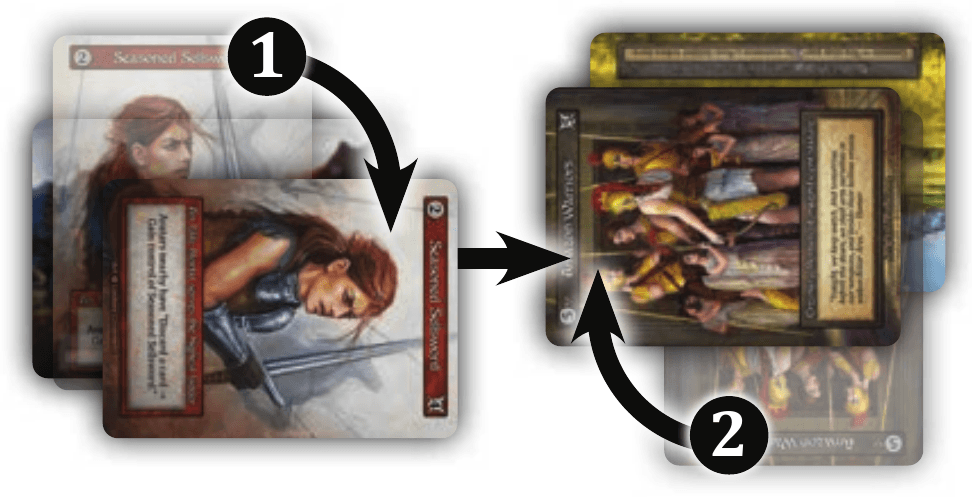
When an using the Move and Attack ability finishes its movement and then chooses not to attack, any of your there may tap to intercept and that .
can not move when they intercept. They must already be at the 's .
Pick Up or Drop Artifacts
Each unit can activate their Pick Up basic ability once per turn, which allows it to pick up any number of artifacts at its that are not currently being carried.
The Drop basic ability allows a unit to drop any number of artifacts it's carrying. Each unit can activate the Drop basic ability once per turn, as long as it hasn't interacted with the this turn. See the Glossary for“.”
Carrying Artifacts
A unit can carry any number of artifacts, which will move with the unit throughout the . If a unit is carrying any artifacts when it leaves the , the artifacts are dropped. If a unit and an artifact it is carrying stop sharing a due to some effect, the artifact ceases to be carried.
Controlling Artifacts
Artifacts carried by a unit are controlled by the player who controls that unit. Artifacts that could be carried but are not currently being carried are uncontrolled. Artifacts that cannot be carried normally (e.g. Automatons and Monuments) are controlled by the player who conjured them.
Building Your Own Decks
Sorcery: Contested is a customizable trading card game, which means that you can choose what cards go into your deck. When you're ready to construct your own deck, there are a few rules you must follow to build decks fit for play:
- You need to choose and include exactly one Avatar card.
- Your Atlas must contain at least 30 site cards.
- Your Spellbook must contain at least 60 spell cards.
You may have larger decks as long as you can reasonably shuffle them.
RARITY
The type line of a spell or site describes the card's rarity①. This tells you how many copies of that card you can have in your deck. Each player may include:
- up to four copies of any cards
- up to three copies of any cards
- up to two copies of any cards
- only one copy of any cards in a deck
Your Avatar does not count toward any of those totals, and is not in that sense a part of either of your decks.
SPECIAL ABILITIES
Most cards in Sorcery have one or more special abilities printed in their game text box that change the default rules of the game or grant new interactions outside of the basic abilities.
Passive Ability
A passive ability has an ongoing effect that is always active, as long as the card is in the relevant game zone. Typically, this zone will be the , but some cards have abilities that specify things they do, or enable you to do, while in your hand, or while in the cemetery, etc.
Keyword Ability
A keyword is a word or phrase that functions as shorthand for a longer piece of rules text. They are used to communicate concepts that require more text than what will fit on a card. You can find these longer explanations in the glossary on page 32.
Activated Ability
An activated ability takes effect simply by stating your intention to do so and paying any related costs, such as tapping or spending . By default, only the controller of a card can use its activated abilities, and only during the main phase of their own turn, when nothing else is already happening.
Triggered Ability
A triggered ability requires that a specified condition is met, or a specified event occurs, to automatically take effect. These abilities can be recognized by their use of words such as“when,”“whenever,” and“at[a specified moment],”though a few cards have nonstandard wording due to space constraints.
Entering a Location, Site, or Void
A unit is said to have entered a , site, or a if it was not occupying that particular spot, and now it is (even if just for a moment as a result of , for example), or when it was summoned or conjured there.
Teleporting
Teleportation effects move a unit directly to a specified without taking any steps in between.
Moving Freely
Some cards can move freely within the or in a defined area. When a unit uses the Move and Attack or Defend abilities they spend no steps when moving, as long as the starting and ending locations of the satisfy the condition.
Special Movement Effects
Some effects will push, pull, or drag things, or simply cause them to be moved. This is forced movement, and is not modified by a unit's abilities, such as , , , or . that cannot move by activating their own abilities, can still be moved by other cards and effects.
If an effect causes a unit to‘take a ’ or‘take up to X steps’ this is not forced movement, and the unit can modify these steps with their abilities. that cannot move by activating their own abilities, also cannot carry out any steps granted by these effects.
When Sites Move
If a site moves to another , everything atop and under it moves with it (however, those cards are not considered to have moved). Generally, a site can only move or be moved to a without another site-a . Any cards in that are now placed atop the site that was moved in.
Carrying Units
Some can carry other . A unit with this ability, picks them up or drops them in the same manner and time as it would artifacts. that have , , , or confer those abilities to they are carrying while they are carried.
A unit being carried may still cast spells or activate abilities as normal. If the carried unit moves to a that the carrying unit doesn't occupy, the unit ceases to be carried.
DAMAGE GRIDS
Some cards have abilities that deal damage or otherwise affect or multiple sites over a wide area. To simplify rules text and illustrate the extent of these spells, some cards contain a damage grid in their rules box.
Damage grids may use a bold to indicate the center of the card's effect, or a dot to show the 's on the grid. By default, a damage grid indicates that the ability deals damage to each unit at locations within the area of effect and within the same , though cards may specify otherwise.
OCCUPYING MULTIPLE SITES
normally occupy only one while in the , however some may occupy multiple locations at once due to their enormous size. Such oversized follow the regular rules for summoning, so you choose a single site you control when you cast the minion spell. As they enter the , you choose a 2x2 area that it can legally occupy, which must include the summoning . To represent the minion's locations, place the card at the intersection of those sites.
An oversized unit is at each of the sites (or squares) that it occupies, so it can be standing on both land and (or squares) at the same time. Therefore, if grid damage is dealt to multiple such locations, oversized take damage equal to the sum of the damage dealt on all of the locations they occupy.
The same applies in general for any effect that checks whether something is true about an oversized unit's site.
When an oversized unit moves, you choose a direction and all parts of it move in that direction. If any part of it can't move in the chosen direction, then it can't move in that direction at all.
When attacking, oversized still only a single or site.
Teleporting Oversized Units
When an oversized unit is teleported, it must be to a or set of locations that conforms to its size restrictions and is otherwise legal for that unit to occupy.
OWNERSHIP AND CONTROL
You have ownership of all of the cards you bring to a game of Sorcery. You are, therefore, the owner of those cards. The owner of a card does not change during the game. A card is always returned to its owner's hand, shuffled into its owner's deck, or sent to its owner's cemetery regardless of who controls the card when it leaves play.
While the owner of a card is most often its controller, control of cards in play may change over the course of a game. When rules text uses phrases like“your minions” or“your sites,” that refers to those things that you control, and not to those things that you own.
PROJECTILES
A projectile's flight begins at the shooting unit's and travels within the same in a cardinal direction. Its flight continues until it either reaches the edge of its or it reaches the first unit ( or ally) along its path, ignoring any allies at the projectile's starting . Different will have different effects, but will most often deal damage to the impacted unit.
In the event of multiple valid , the player that fired the projectile chooses which unit the projectile hits.
STATIC/ONGOING EFFECTS
Auras and minions with passive abilites will have an ongoing impact on the . These static effects should be applied at all times, even while resolving other effects or actions, and take precedence over triggered abilities.
THE STORYLINE
When the story being told during a game of Sorcery starts to get complicated, particularly when multiple abilities trigger at the same time, you can use the to help resolve them.
A begins each time a unit casts a spell or activates an ability at which point one or more events are placed at the relevant points on the and are then resolved in order, one at a time. Sometimes, the resolution of a spell, effect, or event will cause it to split into several smaller events (eg.the individual steps within a unit's movement), which are each placed on the at their relevant points before the continues to play out.
or locations must be chosen as an event is being added to the , otherwise an event only needs more detail when it comes time to resolve it.
Triggered Abilities
If the resolution of one event triggers an ability, a new event will be inserted into the . The new event is added at the current moment, temporarily interrupting any remaining events on the . Once this new event has been resolved, the story will continue.
If multiple events are competing to be added at the same point on the , the non-active player places their events first, then the active player places their events on the after them. If either player has multiple events of their own, they can place them in whatever order they wish.
Your Ghost Ship's movement has resolved③,triggering both its ability and the hunting instincts of the opponent's Giant Shark④.
As the non-active player, your opponent places their ability on the first⑤
If a card leaves the , any of its events stay on the but are unable to resolve. If any event is unable to resolve when it comes up, simply ignore it and continue to the next event.